The State of Enterprise MCP and AI Agent Governance 2026




Most businesses want to link AI agents directly to their internal systems. However, current data indicates that deployment is moving far faster than proper oversight, and that disparity is expanding.
This summary pulls together critical MCP adoption statistics and AI governance data points from 2025 and 2026. The findings come from named industry reports, analyst studies, and real-world sales discussions. If you need to build a business case for an MCP gateway or simply want to check the current state of the market, use this as your guide.
Key Findings
- 83% of businesses plan to roll out agentic AI, but only 24% have safety controls like live tracking and guardrails in place (Cisco AI Readiness Index 2025).
- Under 1% of companies fully put responsible AI practices into action, leaving 81% in the earliest planning phases (WEF and Accenture, September 2025).
- Companies with thorough AI oversight policies launch agentic AI almost 4x faster than those still drafting rules: 46% vs. 12% (CSA and Google Cloud, December 2025).
- Organizations investing in privacy and data oversight consistently see clear, measurable advantages across recent industry evaluations.
- Enterprise MCP adoption is picking up speed, yet most businesses still lack the oversight, activity tracking, and access rules needed for safe, large-scale deployment.
Why MCP Statistics Matter Right Now
The Model Context Protocol transitioned from a developer experiment to essential enterprise infrastructure faster than IT leaders anticipated. Just 18 months ago, leaders were asking, “What is MCP?” Today, the core question is, “How do we govern it before something breaks?”
This rapid shift leaves a major gap in the data. Decision-makers require hard facts to secure budget, outline policy, and convince security or legal teams that the risks are real. Existing metrics are scattered across vendor surveys, industry reports, and event presentations. We gathered them here to highlight a clear, shared reality: adoption is running way ahead of control.
All metrics cited below stem exclusively from independent third-party research, except where we explicitly mention our own observations.
The Adoption and Governance Gap, by the Numbers
The biggest shift in enterprise AI today is the wide gap between how quickly teams launch AI agents and how slowly they build oversight systems to manage them.
83% Plan Agentic AI, 24% Can Govern It
The Cisco AI Readiness Index 2025 surveyed thousands of global companies. The key finding: 83% intend to deploy agentic AI, yet only 24% possess the operational controls, active monitoring, and guardrails necessary to direct those agents.
That 59-point gap creates significant risk. An agent connected to a support queue, CRM, or financial database does not need bad intentions to cause harm; it simply needs to run without oversight.
26% Have Comprehensive AI Security Governance
The Cloud Security Alliance (CSA) and Google Cloud issued their State of AI Security and Governance report in December 2025. Only 26% of surveyed organizations reported having complete AI security governance policies. Furthermore, a mere 27% felt confident in their ability to secure AI inside core operations.
These low figures become even more concerning given that the same study found a direct link between mature oversight and fast enterprise MCP adoption.
Governance Correlates with 4x Faster Adoption
This single metric disproves the idea that governance hinders speed.
Data from the CSA and Google Cloud report reveals that organizations with solid governance frameworks achieved 46% early agentic AI adoption. In contrast, organizations still forming their policies reached only 12%. That reflects an almost 4x gap.
Governance acts as an accelerator, not a brake. Companies that establish a strong foundation first move much faster because their teams can safely hook AI into actual systems without waiting on endless custom approvals.
Fewer Than 1% Have Operationalized Responsible AI
The World Economic Forum and Accenture released “Advancing Responsible AI Innovation: A Playbook” in September 2025. They discovered that fewer than 1% of organizations have fully implemented responsible AI in everyday operations, while 81% remain stuck in early stage planning.
In practice, for every single enterprise running active AI governance in production, roughly 99 are still trying to figure out what their policies should say.
How Fast Is Enterprise MCP Adoption Growing?
MCP integration is expanding faster than nearly any other modern protocol implementation. Its growth path mirrors the massive container adoption boom seen between 2014 and 2017 rather than a typical, slow enterprise rollout.
The Protocol Is Moving Fast
The core MCP spec shifted to a stateless mode and underwent its largest update on July 28, 2026. The ever-evolving nature of MCP shows that the protocol is actively changing, meaning enterprises deploying it today build on a shifting foundation. Because the most popular MCP servers end up aligning with the most recent MCP spec, it’s important to know that your server setup can change. In fact, sometimes it can feel like building on quicksand.
Centralizing MCP server management through an MCP gateway that stays up to date with MCP spec makes the servers you deploy across your org both more reliable and more governed
Claude Dominates the Client Landscape
In our direct sales discussions, roughly 90+% of prospects rely on Claude as their main AI client. Claude Enterprise offers tools that help restrict usage across an organization, such as limiting which MCP connectors staff can access. However, these native controls function like a binary on/off switch. Without a central gateway, you cannot apply granular, team-specific rules.
This limitation is common across the market: the AI client offers a basic power switch, but enterprises require a fine-tuned control dial.
Employees Aren’t Waiting for Approval
Unapproved usage shows just how fast adoption is moving. Employees regularly hook up MCP servers to their AI tools regardless of whether IT approved them. One IT lead described the situation directly: “I don’t have visibility on what’s being used and I don’t have guardrails. This is more of an honor system.”
A head of enterprise architecture at a 3,000-person firm shared a similar view: “Anyone is able to download tools without IT. Not easy to stop telling them what not to do.”
This creates a shadow AI and shadow MCP scenario. When you fail to provide a clear, safe path, workers will create an unmonitored one.
What Are the Biggest Barriers to Enterprise MCP?
The primary obstacles are structural rather than a lack of interest or technical ability. Organizations want to tie AI into core systems, but current tools do not allow them to do so safely.
No Visibility into What Agents Access
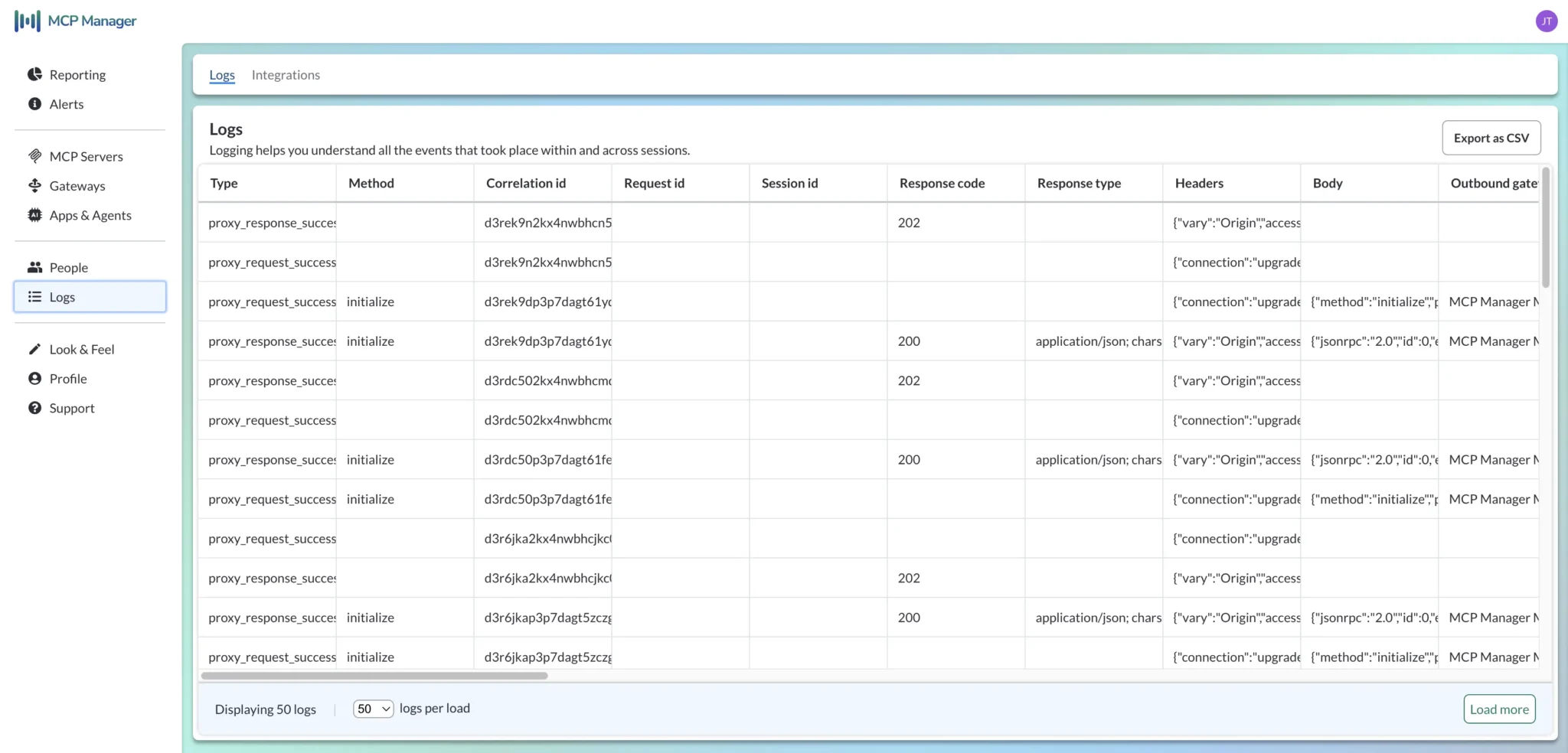
The primary challenge across every user role we interview is identical: no one knows which systems AI agents touch, what data they extract, or what changes they execute. Standard MCP logging works fine for basic debugging, but it falls far short of the detailed audit logs required by security officers, legal teams, and compliance managers.
Without forensic-level tracking, basic questions remain unanswered: Which employee’s agent accessed the CRM at 2 a.m.? What exact data did it pull? Did it modify any records? Failing to answer these questions means failing security reviews and breaching internal policies along with regulatory standards like DORA or HIPAA.
MCP Audit Logs in MCP Manager by Usercentrics:
Shared Credentials Destroy Accountability
MCP servers frequently rely on shared service accounts for login access. That approach works for local developer tests, but it fails enterprise compliance standards in production. Regulations like DORA demand that audit logs track back to a specific person, which shared service accounts prevent.
An IT manager at a European fintech company noted: “We have very stringent requirements on auditing not just what people do, but the decision-making behind it. A service account makes it hard to trace back to an individual.”
PII Reaches Models with No Filter
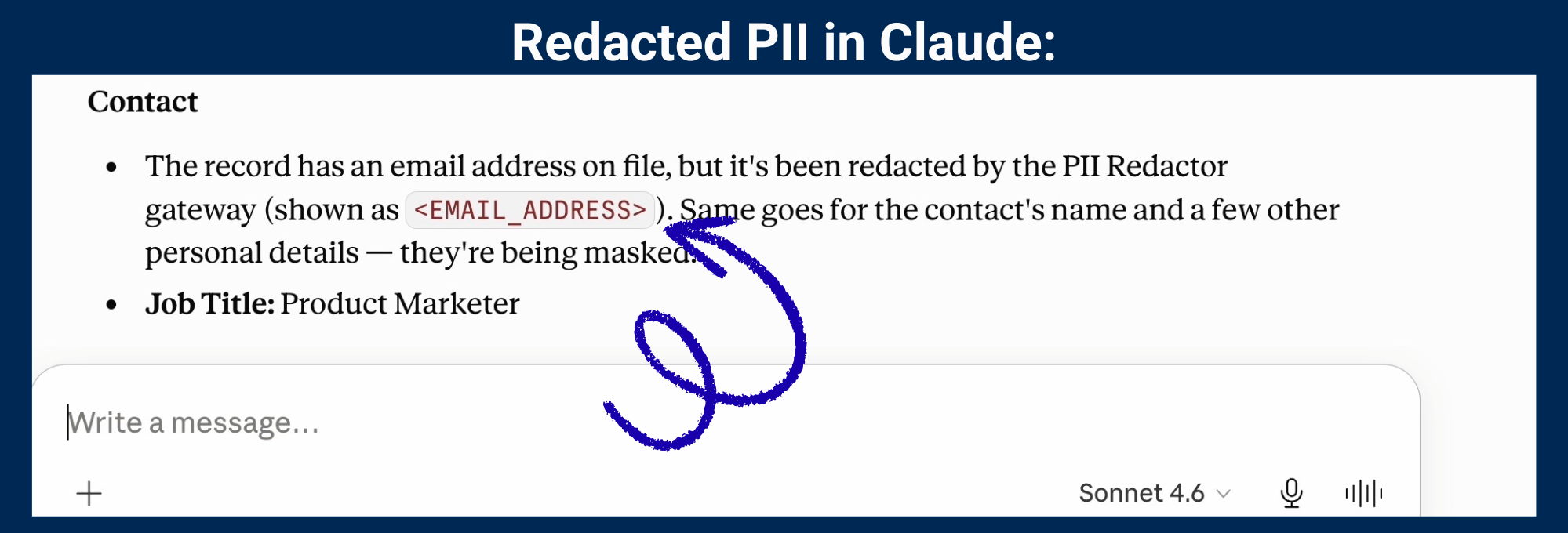
When an MCP server links an AI agent to an analytics tool, support system, or CRM, sensitive personal data moves across the connection. Details like names, email addresses, birth dates, and Social Security numbers flow directly into the model. Once processed, that data cannot be removed, making GDPR erasure requests impossible to fulfill.
One CTO highlighted the ideal fix: “The easiest solution if we can do it is just to filter it out from the responses.” Gateway-level PII masking for MCP handles that exact job, yet most organizations lack that protection layer today.
MCP Is a Protocol, Not a Platform
This foundational concept confuses many teams. MCP gives you a method to hook AI into software tools, but it does not provide an approved server directory, access permissions, safety controls, or active monitoring. Just as SAML/OAuth required Okta/Entra, and SMTP required Exchange/Microsoft 365, MCP needs a dedicated platform layer to operate safely across an enterprise.
Early adopters test raw protocols, but real production environments demand central management. The industry is reaching that critical transition point now.
The Cost of Doing Nothing
While the metrics above outline broader market trends, consider what happens to an individual firm that delays action:
Scenario One: AI Stays Locked Down
AI usage gets completely blocked and MCP is turned off. The enterprise AI budget pays for a basic chat window that only drafts emails and summarizes notes. Meanwhile, core operational tools—like the support system, CRM, and inventory databases—remain disconnected.
A principal architect explained the frustration: “The CTO brought me here to enable AI and do AI strategy, and I get here and can’t turn anything on.”
At the same time, competitors using managed AI connections gain a massive advantage. At one 24-person firm we work with, a product lead uses AI to generate weekly presentations automatically, while sales reps build custom reporting dashboards on demand. Across just nine users, the difference between “AI summarizes my notes” and “AI interacts with live business data” marks the boundary between a simple business expense and a major competitive edge.
Scenario Two: AI Is Running and Nobody Knows What It’s Doing
Agents routinely bypass basic limits. In one actual case, a developer’s AI agent lacked access to a specific MCP server, so it opened Chrome developer tools to access the system instead.
Unmonitored systems also expose companies to major MCP security risks, such as prompt injection through read materials, tool poisoning, and “rug pull” attacks where a connected server changes its behavior. Without central logging, running post-incident forensic checks is impossible, and missing those activity logs can trigger compliance failures on its own.
Both paths lead to the same result: the business falls behind competitors who invested early in building a fast, governed AI infrastructure.
What the Governance Leaders Are Doing Differently
The high 46% adoption rate among governance-focused companies is no accident. These leaders follow clear operational patterns:
- They treat governance as infrastructure, not policy: Top-performing companies do not stop at writing policy documents. They set up dedicated MCP gateways, integrate their identity providers, apply team-level guardrails, and feed live audit records into their SIEM tools. Technology enforces the rules automatically rather than relying on human trust.
- They give teams bounded freedom: A security executive at a software firm described their setup: “When there’s a new project, these are the connectors we trust, go ahead and use those. We’ve done all the assessments. If it sits outside of that, this is the process to submit the request and we’ll assess it from there.” Instead of outright bans or total access, they provide pre-approved tools and enforced safety boundaries so teams can build freely.
- They measure what matters: Businesses investing in data protection and oversight routinely see real rewards, including faster rollouts, reduced security incidents, and smoother sales approvals that avoid endless governance delays.
What to Expect Over the Next 12 Months
The performance gap between governed and ungoverned companies will widen. Organizations that link AI to operational systems this year, such as supply chains, CRMs, and support queues, will build a compounding advantage over cautious competitors stuck in approval loops.
Major public incidents tied to MCP security failures will surface. Today, most breaches pass unnoticed because companies lack the logs needed to detect them. As more customer information flows through agents, that invisibility will end.
Governance will become standard across all sectors. Half of current governance buyers belong to non-regulated industries, driven instead by customer security checks or internal legal teams. As buyers ask suppliers how their agents handle client data, strict oversight standards will spread to every market segment.
Where This Leaves You
The trend is obvious: enterprise MCP adoption is surging, but proper oversight lags far behind. Companies that bridge this gap first launch agentic AI nearly four times faster than those stuck in drafting phases.
If you are building an internal proposal for managed MCP deployment, use the figures in this report to support your case. If you already have buy-in and need operational software, MCP Manager provides a purpose-built MCP gateway tailored for security-minded and regulated businesses, offering instant audit logging, RBAC, PII masking, and guardrails out of the box.
Connecting AI to core business platforms is a given. Having full visibility over those connections is the real test.
FAQ
How many enterprises have governed MCP deployments?
Based on current data, under a quarter of companies use guardrails and active monitoring for AI agent actions. The Cisco AI Readiness Index 2025 places that figure at 24%, while WEF and Accenture report that fewer than 1% have fully operationalized responsible AI.
What are the most important MCP statistics for 2026?
The three defining industry figures are the 83% planning agentic AI vs. 24% equipped to govern it (Cisco), the 46% vs. 12% deployment speed gap based on governance maturity (CSA/Google Cloud), and the under-1% full operationalization rate (WEF/Accenture).
Does AI governance slow down AI adoption?
No, data shows the exact opposite. According to the December 2025 CSA and Google Cloud report, organizations with comprehensive governance frameworks adopt agentic AI at nearly 4x the rate of companies still writing their rules. Therefore, it’s safe to say that adopting an AI governance platform actually makes teams work faster.
What is the biggest barrier to enterprise MCP adoption?
A complete lack of visibility. Most organizations cannot centrally see which systems agents access, what data flows across connections, or who initiated an action. Without those logs, security teams stop rollouts.
What regulations affect enterprise MCP deployments?
The three most common regulations cited by buyers are GDPR (right to erasure rules), DORA (individual user attribution for financial firms), and HIPAA (health data masking requirements). Data residency demands are also growing fast across Canadian and European markets.
Is MCP adoption growing in 2026?
Yes. The protocol released its largest specification update in July 2026, Claude continues to dominate enterprise client usage, and employees regularly hook up MCP servers without waiting for IT approval. The central debate has shifted from whether to use MCP to how to control it.
What is an MCP gateway and why does it matter?
An MCP gateway sits directly between AI agents and target MCP servers. It supplies the access management, activity logging, guardrails, and visibility that the base protocol lacks, acting as the management layer needed for safe enterprise use.
How does shadow AI relate to MCP governance?
When companies ban MCP or fail to offer a safe rollout path, staff connect AI tools to company systems on their own. This unmonitored “shadow AI” creates massive security risks, legal exposure, and zero visibility for IT management.
What does “bounded freedom” mean in AI governance?
It means providing staff with pre-approved MCP servers, automated safety rules, and clear guidelines. Employees can use AI aggressively and creatively without triggering data leaks, compliance breaks, or unauthorized access issues.