Non-Human Identity: What It Means for AI Agents and MCP Security




A non-human identity (NHI) is any digital login credential assigned to a software program, hardware system, or AI agent rather than an individual person. Examples include API keys, OAuth tokens, automated bots, service accounts, and AI agents. Put simply: if an entity logs into a network and is not a person, it counts as an NHI.
For software engineers and cybersecurity specialists implementing the Model Context Protocol (MCP) inside a business, non-human identities represent an expanding blind spot. Every time an AI agent links to a ticketing platform, a CRM, or a software repository, it establishes a new identity that legacy identity and access management (IAM) tools were not built to monitor.
This guide explains what non-human identities are, why they pose unique challenges for MCP setups, how to enforce individual user tracking instead of using shared logins, and how to properly audit NHI operations in practice.
Quick Overview
- A non-human identity is any system credential utilized by a machine, software service, or AI agent instead of a human.
- NHIs far outnumber human accounts in modern organizations, a trend accelerated by AI agent adoption.
- Using shared service credentials makes audit tracking impossible; routing access through SSO-based individual user identities fixes this issue.
- The standard MCP protocol does not include built-in identity governance, requiring a dedicated gateway layer to enforce control.
- MCP Manager links every tool interaction triggered by an MCP agent directly back to the human who started it, even if the underlying system uses a shared account.
What Counts as a Non-Human Identity?
A non-human identity encompasses any credential that completes authentication without an individual physically typing in a password. This category is broad and continues to expand.
Traditional NHI
Traditional NHI examples are:
- Service principals
- API keys
- Certificates
- OAuth client credentials
- Managed identities
- Bot profiles
- Service account
These assets have been used for years, and most organizations maintain thousands of them, often forgotten, unmonitored, or overly permissive.
AI Agents
The modern additions to this category are AI agents. When an AI agent connects to GitHub through MCP, it logs in using an authentication token. That token is an NHI. When the agent checks a Jira project, queries a CRM, or updates a database, every interaction relies on an NHI. Unlike standard service accounts, AI agents act independently, decide on their own which tools to trigger, and can string together actions across multiple applications in a single workflow.
Because of this autonomy, managing non-human identities requires a different approach than human IAM. The overall volume of credentials is far higher, system behaviors are less predictable, and a compromised credential can cause damage across a much broader area.
Why Non-Human Identities Matter for MCP Deployments
MCP serves as an open protocol rather than a complete software platform. It standardizes how AI agents communicate with external databases and applications, but it lacks built-in identity governance, permission management, or compliant audit logs.
This structural gap creates three primary challenges:
- Shared logins destroy accountability. Teams frequently route all MCP connections through a single shared service account. If an incident occurs, administrators cannot track the activity back to the person responsible.For EU financial entities subject to DORA, audit logs must trace back to a specific identity. Shared credentials break this requirement completely.
- Agents gain excessive permissions. When a person opens a file folder, they view a few items manually. When an AI agent accesses that same folder with identical rights, it can read every document instantly and send that data to an external model. Safe permission levels for a human do not translate to safe permission levels for an AI agent.
- Untracked assets cause governance gaps. Without a centralized registry, organizations lose track of how many active NHIs are tied to their MCP tools. Enterprise architects routinely point out this issue: sprawling technical infrastructure with unclear ownership across DevOps, IT, and software leads. Industry trends show this management gap widening, made worse by “Shadow AI” where employees connect unapproved agents to MCP servers, generating hidden NHIs that IT teams cannot monitor.
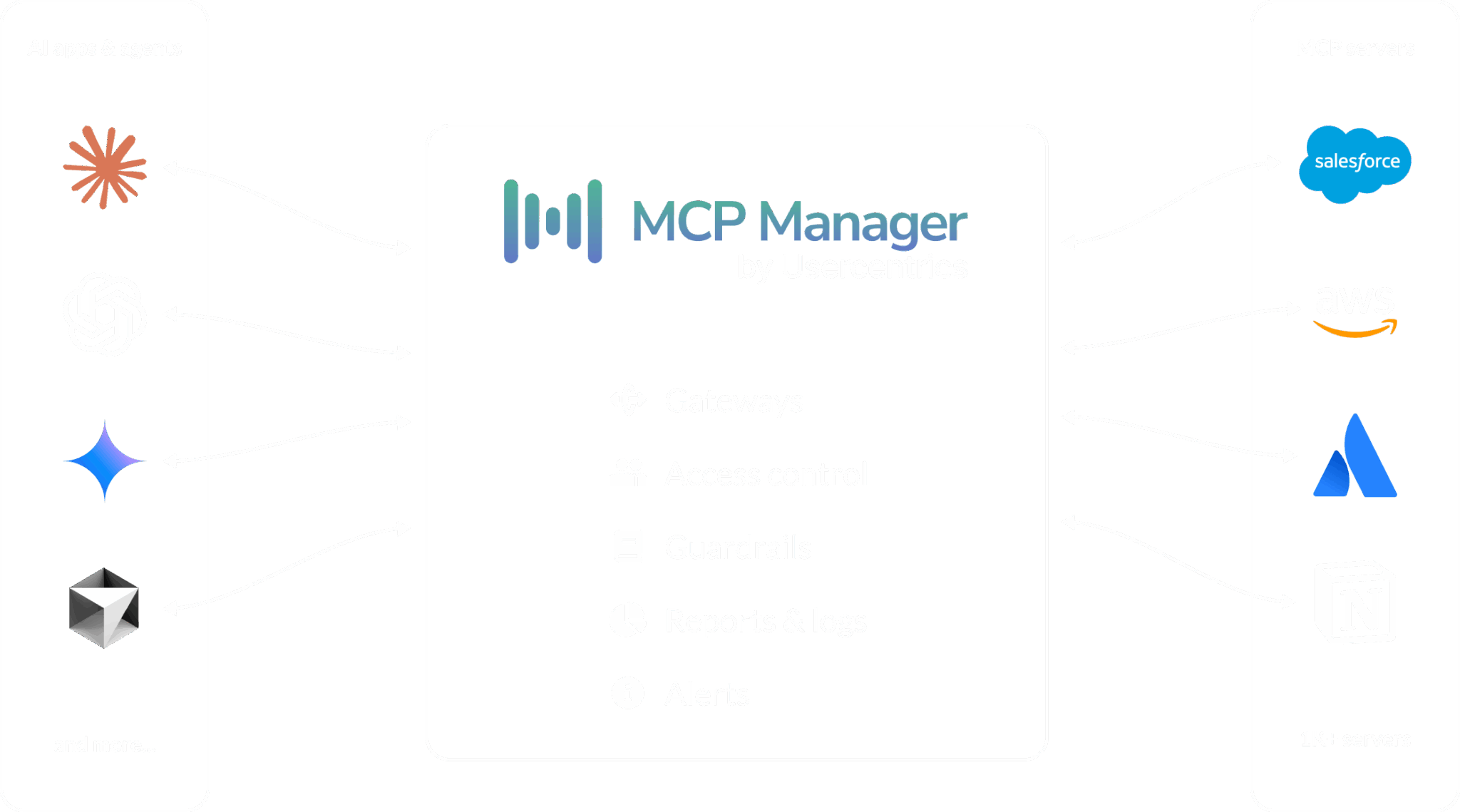
MCP gateways help manage agents accessing data and tools via MCP
How to Enforce Per-User Identity for MCP
Resolving the risks of shared credentials requires per-user identity mapping: every action executed by an MCP tool must tie directly back to the specific person who initiated the request, regardless of the shared service account running in the background.
To implement this model effectively:
- Integrate SSO with your Identity Provider: Connect the MCP gateway directly to platforms like Okta, Microsoft Entra ID, Keycloak, or Google Workspace using OIDC. Staff members log in once using standard corporate credentials, eliminating manual logins or sharing tokens over internal chat tools.
- Automate user lifecycle with SCIM: Automatically remove a user’s MCP permissions when they leave the organization. Without automated SCIM provisioning, teams must manually rotate shared API keys. This is a common cause of lingering, abandoned NHIs.
- Replace shared accounts with individual OAuth: Certain MCP servers support dynamic client registration (such as Atlassian), while others require personal access tokens (such as GitHub). MCP Manager manages both setups using a unified gateway URL. Most importantly, even if the destination server runs on a shared account, the gateway tracks which human triggered the request.
- Scope access by team and gateway: Limit access based on operational needs, RBAC, and permissions. In MCP Manager, admins provision a team to specific gateways, and each gateway exposes only the tools that admins provision on it. Example: customer support can be given a gateway carrying only the CRM’s read and write tools (but no destructive tools), while the platform team gets one carrying the full set.
What is an MCP gateway?
Find out by watching the video below. 👇
How to Audit Non-Human Identity Activity
Standard event logs are a common weak point in NHI management. Default MCP logs help debug technical errors, but they lack the detail required for regulatory compliance and forensic investigations.
An effective audit system requires contextual metadata, including:
- The specific person who launched the request.
- The specific AI client used.
- The destination MCP server that responded.
- Any sensitive data detected in the request or response.
- Any security policy alerts triggered during execution.
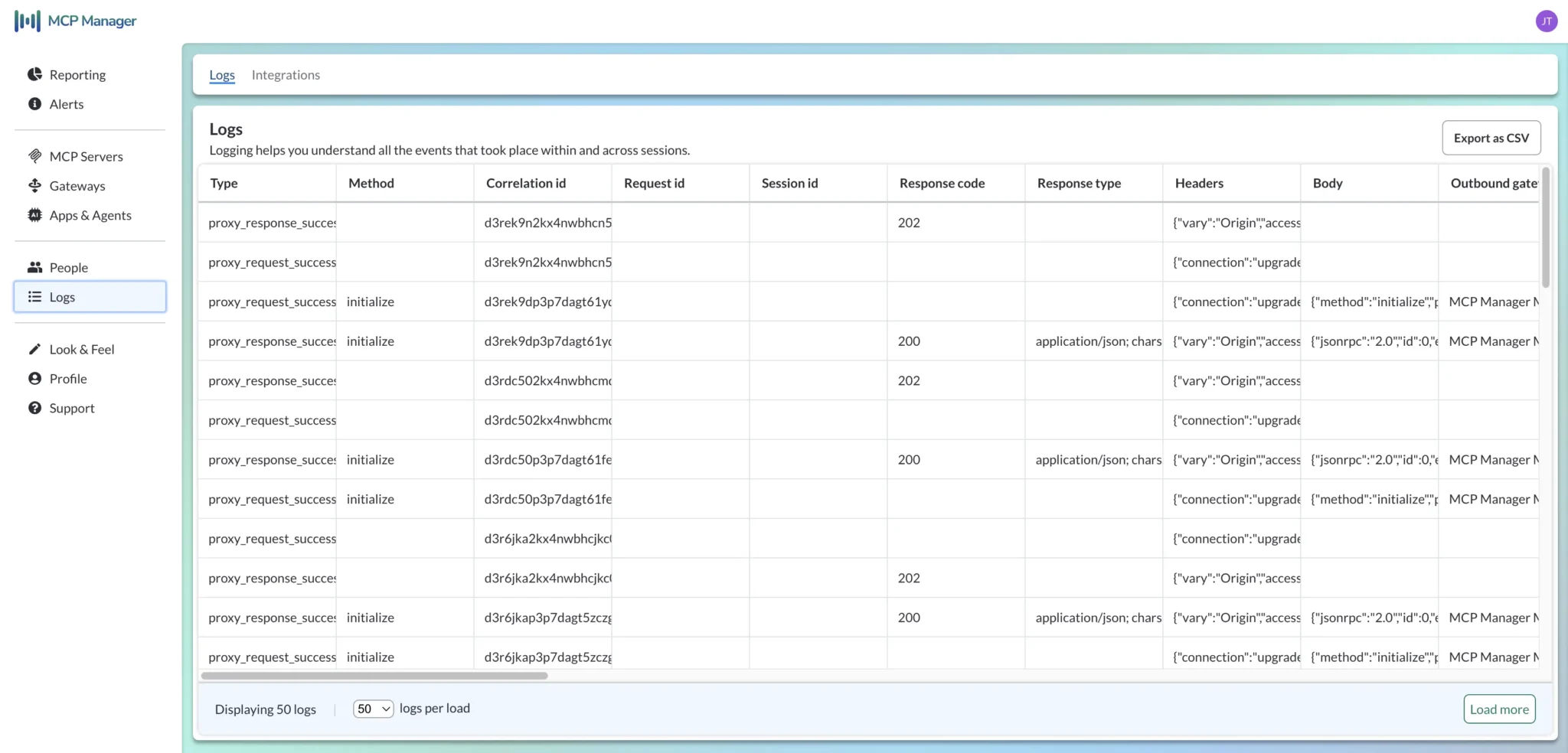
MCP Manager delivers this functionality through detailed event logs that record every tool request alongside the initiating user’s identity. For orgs using enterprise observability and security platforms (e.g., Datadog, Grafana Cloud, Honeycomb), these logs stream via OTel.
This level of tracking is mandatory in regulated fields:
- DORA: Its technical standards require EU financial entities to limit generic and shared accounts. In addition, orgs must ensure users are “identifiable for the actions performed in the ICT systems at all times” (Commission Delegated Regulation (EU) 2024/1774, Art. 21).
- HIPAA: Mandates logging for all access to medical records, tracking precisely who viewed or modified patient data.
- General Security: Security evaluations across all sectors increasingly require clear documentation showing exact access history by user and timestamp.
Without these tools, organizations rely on an unmonitored “honor system,” leaving them with no visibility, no preventative controls, and no way to analyze past incidents.
MCP Manager Provides Audit Logs for HIPAA and DORA Compliance:
Non-Human Identity vs. Related Terms
- Machine Identity: The overarching category that includes hardware tokens, security certificates, and cloud infrastructure identities. Non-human identity is a subcategory focused specifically on software-based credentials, API keys, service accounts, and agent tokens.
- Service Account: A distinct form of NHI designed for background software processes. In MCP setups, traditional service accounts hide individual user attribution.
- MCP Authorization: The protocol’s OAuth 2.0 standard for HTTP-based transports (where the AI client presents a bearer token on every request). It hands auth, but does not manage user lifecycle, security/governance, or individual user tracking. That level of control requires a gateway tool.
- Workload Identity: A cloud infrastructure term (such as Microsoft Entra Workload ID) used to authenticate cloud services. It is a type of NHI rather than a separate category altogether (and it does not cover AI agents connecting via MCP).
Summary
Every new MCP connection introduced to an enterprise environment creates another non-human identity. Without precise user tracking, unified logging, and fine-grained access rules, these credentials turn into an unmonitored security risk that expands alongside your AI agent adoption.
MCP Manager provides the control required to govern non-human identities across local and cloud-based MCP servers without changing the end-user experience. Employees simply open their AI tools, sign in once, and work as normal, while security controls operate seamlessly in the background.
If your team uses MCP today without a reliable way to trace system access down to individual users and timestamps, establishing that visibility should be your immediate security priority.
Explore more how you can stay compliant and secure while deploying MCP at scale by booking an MCP Manager demo or watching one of our many webinars.
FAQ
What is a non-human identity in AI security?
A non-human identity is any credential that validates a software program, system, or AI agent instead of an individual person. In AI security, this includes API tokens and service accounts used by AI agents to interact with software platforms and data sources through protocols like MCP.
How do I enforce per-user identity for MCP instead of shared credentials?
Link your central identity provider (such as Okta, Entra ID, or Google Workspace) to an MCP gateway using SSO. This setup matches every tool action to the specific person who initiated it, even if the destination MCP server uses a shared credential. SCIM support ensures accounts are revoked automatically when employees leave.
How do I audit non-human identity activity?
Deploy an MCP gateway that logs user attribution, requested tools, and data types for every operation. Connect these logs to your existing SIEM platform using OpenTelemetry for secure storage and security analysis.
What is the difference between a service account and a non-human identity?
A service account is just one specific type of non-human identity. NHI is a broader term covering API keys, OAuth tokens, certificates, bot accounts, and AI agent logins. While service accounts are usually shared, complete NHI governance connects system activities back to individual people.
Why are non-human identities a growing security risk?
NHIs drastically outnumber human user accounts in most companies, and AI agent rollouts are expanding that gap. Unlike standard user accounts, NHIs rarely feature multi-factor authentication, regular password updates, or automated offboarding. If an agent token is stolen, attackers gain access to every system connected to that agent.
How does non-human identity management differ from traditional IAM?
Standard IAM manages human users through passwords, multi-factor authentication, and assigned roles. Non-human identity management governs background credentials that bypass normal login screens such as access tokens and active agent sessions. It requires automated provisioning, tool-level access controls, and systems that trace automated machine actions back to the human who started them.