The Best MCP Gateway Options for DevOps Teams




Because DevOps teams are responsible for improving the speed of software delivery, they are usually the first to wire AI agents into production infrastructure. However, they’re also responsible for the reliability of said software too. Therefore, they’re often the first to feel the pain when there’s no governance layer managing and securing those connections.
Agents touching CI/CD pipelines, Kubernetes clusters, monitoring systems, and infrastructure-as-code tools need the same operational discipline as any other production workload. An MCP gateway brings that discipline by centralizing:
- authentication
- access control
- observability and audit logs
- policy enforcement for every agent-to-tool interaction
- PII and sensitive data detection
MCP Gateways turn ad-hoc agent connections into governed, observable infrastructure that DevOps teams can manage like anything else in their stack. This guide covers the best MCP gateway options for teams that recognize that want to go about deploying stable and secure MCP-powered AI workflows. After all,
Why DevOps Teams Need an MCP Gateway
MCP Gateways Provide Agents Production-Grade Operations
While agents connected to GitHub, CI/CD pipelines, Kubernetes APIs, and monitoring tools are production workloads, they’re rarely treated that way. Because not all enterprises use a gateway, agents often manage their own credentials, error handling, and access scope. DevOps exists to eliminate this exact kind of undisciplined sprawl.
Credential Management Becomes More Manageable with Gateways
Every MCP server connection requires credentials. As agents connect to more tools, the number of tokens, API keys, and OAuth flows to manage grows multiplicatively. A gateway centralizes credential injection and rotation. Handling secrets in one place rather than scattered across agent configurations is an MCP security best practice.
MCP Gateways Remove Observability Gaps Break Incident Response
When an agent triggers an unexpected CI run, modifies infrastructure, or writes to a database it shouldn’t have accessed, DevOps needs to trace what happened. Without centralized MCP server logging of every tool call, debugging agent-caused incidents is guesswork.
MCP Gateway Overview
By providing a central layer between MCP servers and agents, gateways are a critical component to safe and governed AI deployments. If you want an overview of how gateways provide MCP observability, security, PII redaction from MCP servers, and other enterprise-grade functionality, you can check out the video below.
MCP Manager by Usercentrics
Best MCP Gateway for DevOps Teams That Need Governance Without Building It
MCP Manager gives DevOps teams production-grade MCP governance with little setup needed.
Teams get runtime guardrails, RBAC, audit logging, PII detection, and real-time monitoring without having to build or maintain that infrastructure internally. An org-wide private MCP registry lets teams maintain an approved set of servers that decreases shadow MCP use in an org. These registries are where employees can also easily install them across their AI clients (e.g., Cursor and Claude) with one-click installation. This easy installation is important for non-technical team members that want to safely configure local and remote MCP servers.
MCP Manager also offers functionality like:
- Tool-level RBAC so teams can scope access at a granular level
- Runtime guardrails that enforce policy in real time, not just at setup
- PII detection for sensitive data moving between agents and MCP servers
- Dashboards and audit logs built for both engineering observability and compliance reporting
- Integrations with SSO, SIEM via OpenTelemetry, and AWS Bedrock
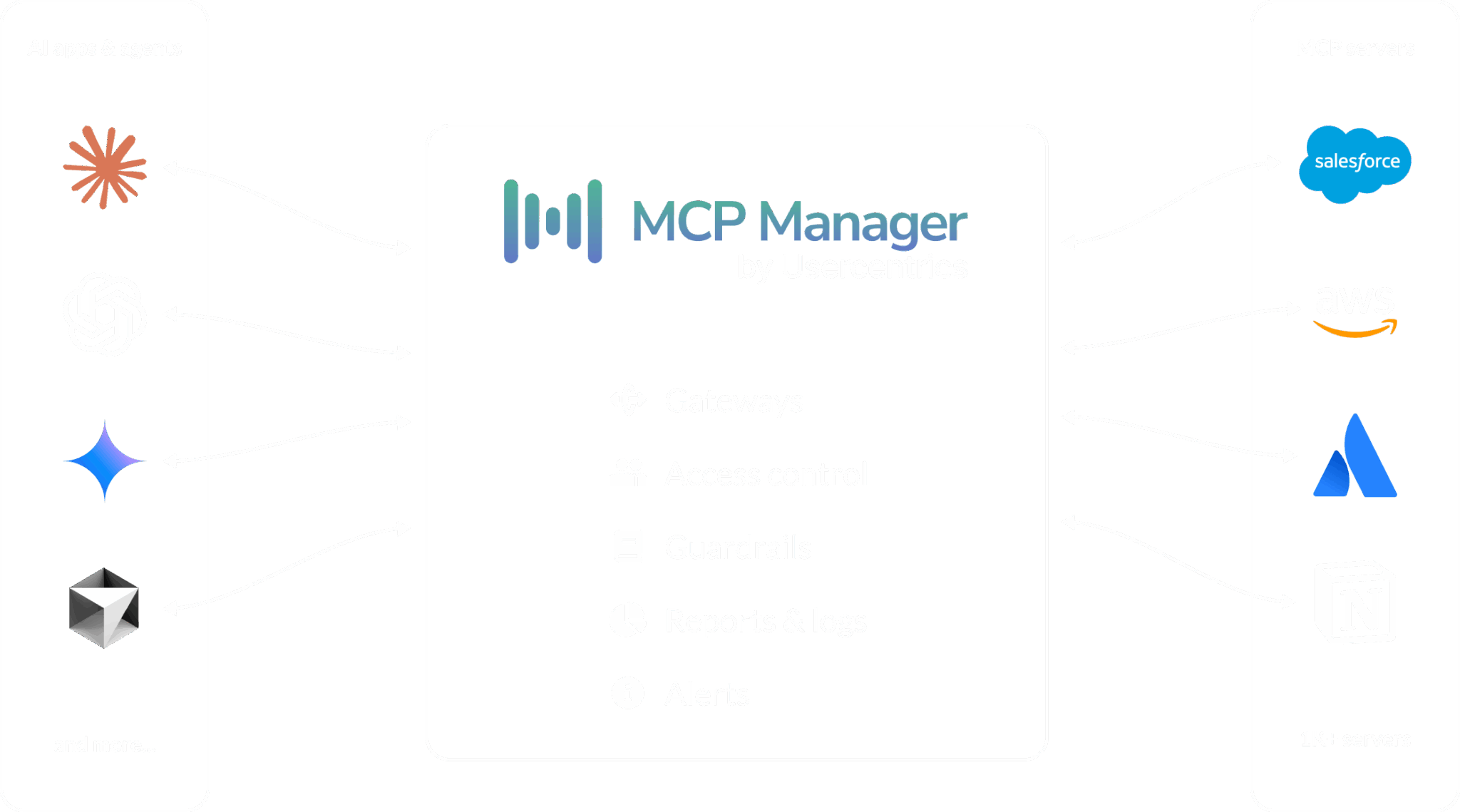
For DevOps teams, the most valuable features are tool-level MCP permissions and provisioning, where admins can control which agents access which toolsets. Admins also real-time alerts when agent behavior deviates from expected patterns and MCP security prevention from risks like data exfiltration, tool poisoning, MCP rug pull attacks and more.
Pricing scales with the capabilities you use, unlike other enterprise-grade MCP gateways that start at $25,000+ annually. You can try MCP Manager for free by booking an onboarding call.
Docker MCP Gateway
Best for DevOps Teams That Want Container-Native MCP Operations
Docker’s MCP Gateway is the most operationally familiar option for any DevOps team already working with containers. It’s a best practice to containerize local MCP servers. Docker extends this best practice for all MCP servers. It’s also open source (and, therefore, free), ships as part of the MCP Toolkit in Docker Desktop, and runs each MCP server in its own isolated container with restricted privileges and network access.
For DevOps, Docker’s appeal is the operational model:
- container lifecycle management
- profile-based server configurations for consistency across environments
- credential injection through Docker Desktop’s secrets management
- interceptors for policy enforcement including secret blocking.
The gateway handles MCP OAuth flows and supports OpenTelemetry for integration with existing observability stacks. Docker also provides access to over 200 MCP servers through the Docker MCP Catalog, and you can manage server configurations declaratively using Docker Compose, which fits neatly into infrastructure-as-code workflows.
The ceiling for Docker is governance depth. There’s no multi-team RBAC, no PII detection, and no compliance-grade audit trail with identity attribution. When we recently talked to 100+ organizations deploying MCP, RBAC was especially important for security-conscious teams.
For DevOps teams in prototyping mode or running individual developer environments, Docker is ideal. However, for teams managing agent access across multiple engineering squads, you’ll need more.
Bifrost by Maxim AI
Best for DevOps Teams Where Gateway Latency Is a Constraint
Bifrost is an open-source AI gateway built in Go that serves as both an LLM router and an MCP gateway in a single binary, which means one deployment to manage instead of two separate pieces of infrastructure. For DevOps teams optimizing for operational simplicity and performance, that consolidation matters.
At sustained loads of 5,000 requests per second, Bifrost adds roughly 11 microseconds of overhead. It supports all three MCP connection protocols (STDIO, HTTP, SSE), virtual keys with tool-level scoping for access control, OAuth 2.0 with automatic token refresh, and built-in observability through Prometheus metrics and OpenTelemetry tracing. Bifrost deploys via NPX (30-second setup), Docker, or Helm charts for Kubernetes environments.
Bifrost also supports Code Mode, which a technique originally pioneered by Cloudflare; this technique lets LLMs write orchestration code instead of loading tool schemas into context. Some studies show this technique reduces consumption by 50% or more across multi-server workflows.
The open-source core is Apache 2.0. Enterprise features including guardrails, clustering, vault integration (HashiCorp Vault, AWS Secrets Manager, Google Secret Manager, Azure Key Vault), RBAC, and federated authentication require a commercial agreement. DevOps teams that need deep compliance tooling or PII detection will find those gated behind enterprise pricing.
Obot
Best for DevOps Teams Building an Internal MCP Platform
Obot is an open-source MCP platform, providing server hosting, searchable registry, gateway routing, and built-in chat client. Obot also works within Kubernetes-native infrastructure. For DevOps teams responsible for building an internal platform that other teams consume, Obot provides the building blocks without vendor lock-in.
The operational model aligns with how DevOps teams already work. Server configurations can be managed through the admin UI or GitOps workflows, MCP servers run as containers in your Kubernetes cluster with per-user isolation, and the gateway proxies all traffic with MCP authentication enforcement and audit logging. A companion shim alongside each server handles authorization and token exchange, keeping secrets isolated from the MCP server process itself.
The open-source edition integrates with GitHub and Google for identity. The Enterprise Edition adds Okta and Microsoft Entra. The tradeoff is that you own operations entirely; deployment, scaling, patching, and monitoring are your team’s responsibility. However, for many DevOps teams, that’s often their preferred way of working.
TrueFoundry
Best for DevOps Teams Managing the Entire AI Stack
TrueFoundry is a Kubernetes-native AI platform that collapses model serving, LLM routing, MCP gateway, deployment pipelines, and observability into a single control plane. For DevOps teams that are already responsible for the full AI infrastructure (and not just MCP governance) TrueFoundry reduces the number of systems to operate.
TrueFoundary offers capabilities like:
- integrations with existing CI/CD pipelines (GitHub Actions, Bitbucket Pipelines, Jenkins),
- GitOps-driven deployment support
- cost attribution via OpenCost at the per-service and per-namespace level
- Monitoring that plugs into Prometheus, CloudWatch, DataDog, NewRelic, and ELK stacks.
Their MCP gateway also includes a centralized registry, OAuth 2.0 with federated IdP support, RBAC, and Virtual MCP Servers for curating tool access per team. TrueFoundry deploys within your VPC on AWS, GCP, Azure, or on-premise infrastructure. Pricing starts with a free trial, then $499 and $2,999/month tiers before enterprise pricing.
The tradeoff: TrueFoundry is a broad AI platform, and the MCP gateway is one component within it. DevOps teams whose sole need is MCP governance will find purpose-built solutions more focused. DevOps teams managing the full AI lifecycle will find TrueFoundry’s consolidation compelling.
Choosing the Right MCP Gateway for Your DevOps Team
Ultimately, the MCP gateway that is the best for your DevOps team boils down to what you actually need, value, and how you function as a team. Here’s a quick overview of the options that we went over.
Container-native operations, fast prototyping: Docker. Free, familiar, operationally simple.
- Great way to get started with more secure MCP usage internally
Production MCP governance without building it yourself: MCP Manager. Purpose-built governance with SIEM integration, RBAC, and audit trails
- Ready to operate on day one. You can learn more about MCP Manager and book a free trial.
Maximum performance, minimal overhead: Bifrost. Lowest latency available on the market.
- Dual LLM + MCP gateway in one binary. Helm-deployable
Building an internal MCP platform on Kubernetes: Obot offers a full platform with registry, hosting, and GitOps workflows
- Open source and free to start out with
Managing the entire AI infrastructure: TrueFoundry
- One control plane for models, tools, agents, and deployment pipelines
The right gateway for DevOps is the one that fits your operational model. If you treat MCP like any other production workload, with proper observability, access controls, and incident response.
MCP governance is important for DevOps teams that are seriously considering the role AI has for DevOps professionals. For teams that are deploying MCP at scale, an MCP gateway is absolutely table stakes. We go over why in the video below. Or you can schedule time to chat with us about your MCP deployment strategy and get free access to our MCP gateway.