The Best MCP Gateway Options for Startups




Startups are leading with the way with MCP adoption, wiring agents into codebases, customer data, communication platforms, and internal APIs to automate work that would otherwise require headcount. The appeal is obvious: agents that can actually do things.
But connecting agents directly to your production systems without a control layer is how startups end up with security incidents, runaway token costs, and compliance gaps that block enterprise deals.
An MCP gateway sits between your agents and the tools they access, handling authentication, access control, observability, and policy enforcement. For startups, the right gateway is the difference between shipping AI features confidently and hoping nothing breaks.
This guide covers the best MCP gateway options for startups and how to think about which one fits your current stage, priorities, budget and team composition.
Why Startups Need an MCP Gateway
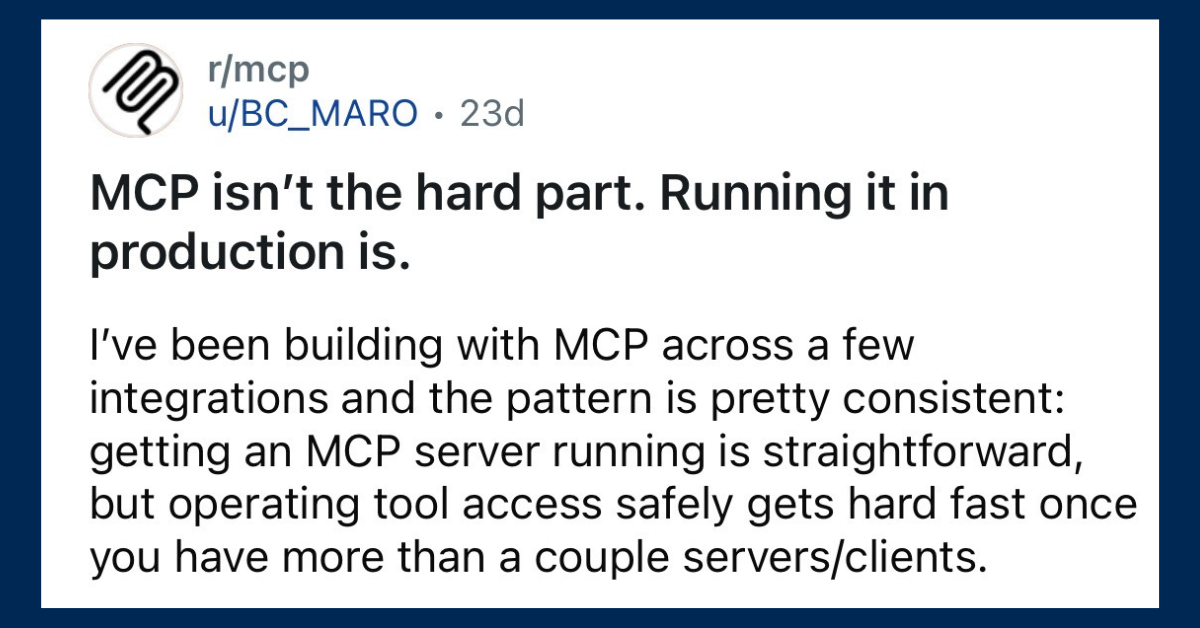
When it’s just two engineers and a handful of tools, wiring agents directly to MCP servers feels fine. The problems show up the moment anything starts working well enough to scale. Or, as this Reddit user succinctly said:
MCP Gateways Prevent Security Risks You Aren’t Thinking About
We’ve all read the headlines about nefarious attacks, such as prompt injection, tool poisoning, rug pulls and data exfiltration. These attack vectors can (and do!) target any MCP deployment where agents have access to sensitive data and the ability to take actions.
A compromised agent with write access to your production database or customer records can do real damage, and startups rarely have incident response playbooks ready.
An MCP gateway enforces security policies at runtime, blocks dangerous operations, detects unusual behaviour, and provides you alerts. This allows engineers to focus on building instead of putting out fires.
MCP Gateways Give You Visibility & Satisfy Enterprise Prospects
Startups selling to businesses inevitably face security questionnaires, SOC 2 audits, and procurement reviews. These processes want to see evidence that you know which agents access which systems, who authorized that access, and what data moved where. Building that audit infrastructure after a prospect asks for it means delays that can kill a deal.
An MCP gateway that records every tool interaction with full context. You need to log which agent, which tool, what parameters, what result, etc to be enterprise-ready. You compliance posture is important, as is your team’s ability to observe what’s actually going on.
Token Spend Is Real Money on a Startup Budget
Every tool in an agent’s manifest eats context window tokens before the agent does any useful work. When popular MCP servers expose 30, 40, or 50+ tools each, the waste accumulates across every agent invocation. At startup scale, unnecessary token consumption is money that should be going toward product development or growth.
A gateway that filters which tools are visible to which agents keeps manifests tight and token budgets under control. Some gateways also offer intelligent caching and rate limiting that further reduce costs — features that pay for themselves quickly.
MCP Gateway Overview
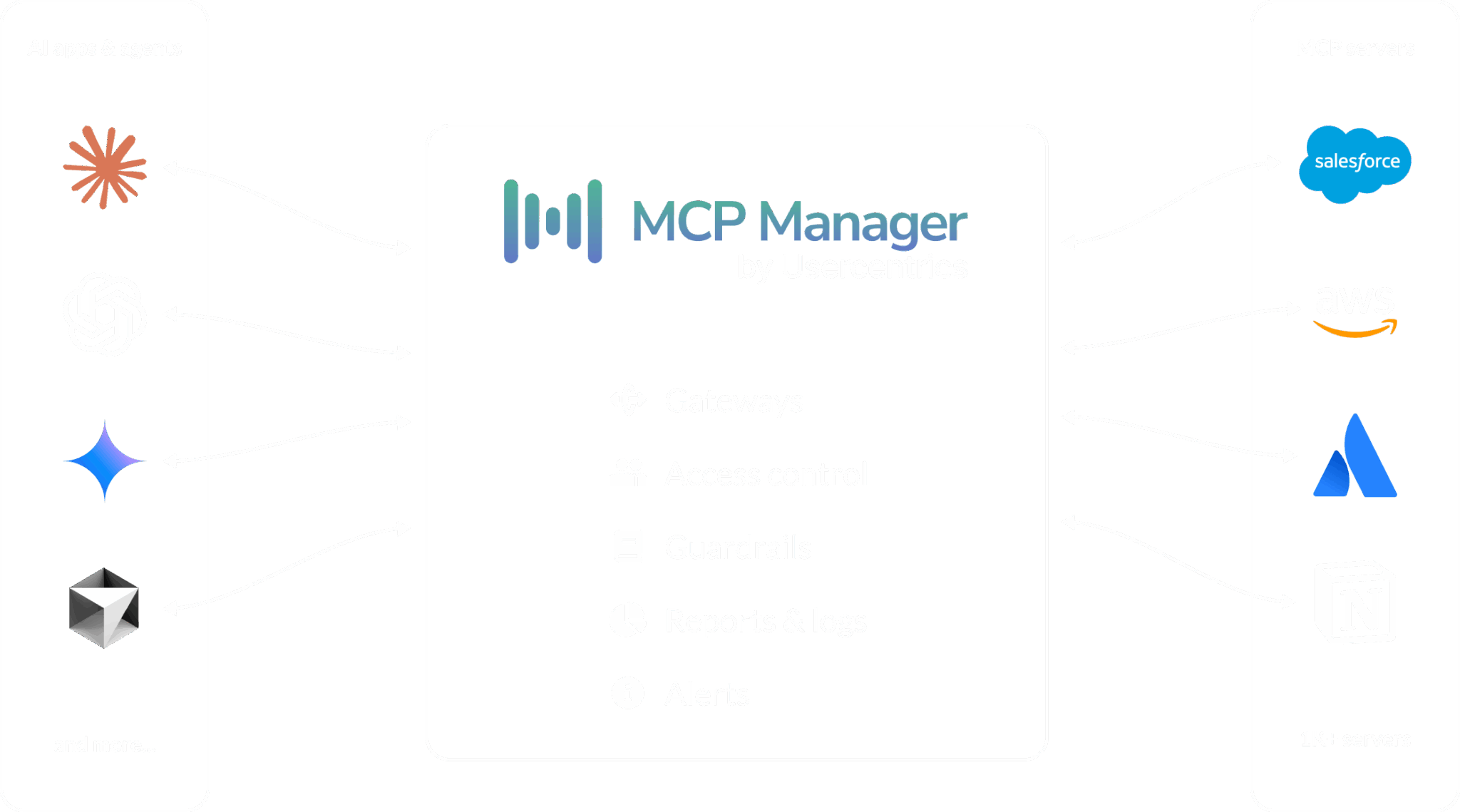
An MCP gateway is a central layer between your agents and MCP servers, which enforces policies, provides observability, and makes it easier to get MCP up and running at scale.
Below is an overview of how they actually work.
MCP Manager by Usercentrics
Best & Most Cost-Effective MCP Gateway for Startups That Are Scaling
The most expensive gateway decision a startup can make is choosing something that works for prototyping but has to be replaced once real customers, compliance requirements, or team growth enter the picture. MCP Manager prevents that rebuild by offering enterprise-ready features and functionality alongside affordable pricing tiers that scale with the company.
While many MCP gateways are priced for enterprises (many of which start at $25,000+ / year), MCP Manager’s pricing scales with the features and functionality your team actually uses. This pricing structure makes it realistic for seed-stage and Series A companies that need governance but aren’t ready for enterprise contracts.
What MCP Manager’s gateway gives startups:
- Runtime security enforcement: Even startups need protection against prompt injection, tool poisoning, and rug pull attacks—especially because they don’t have a dedicated security team that can configure or monitor AI traffic. MCP Manager provides the guardrails, alerts, and anomaly detection work out of the box.
- RBAC & ABAC: Hierarchies exist even within small startups. Teams can decide which agents and team members can reach which tools and operations. As your team grows from five to fifty, access policies scale without manual reconfiguration for each new hire.
- PII and sensitive data detection: Using both Regex-based filtering for common patters and Presidio’s pre-trained PII detection (which can also catch API keys), MCP Manager stops sensitive data from ever reaching an LLM. For any startup handling user data or sensitive credentials and API keys, this is necessary.
- Verbose audit trails: Even if your startup doesn’t need to be compliant, it’s wise to keep logs of tool calls is with agent identity, tool name, parameters, and results. When your first enterprise prospect sends a security questionnaire, the answers are already there. And it also makes debugging way easier. Plus, you can’t secure what you can’t see.
- Team and tool provisioning: Control which MCP toolsets each team and agent can see. This reduces token waste from bloated tool manifests and makes it safe to give non-technical team members access to specific capabilities without making their agents overly privileged.
- Centralized dashboards and real-time alerts: Get one view of all agent activity across your organization, with notifications when something looks off. See realtime charts with token use, agent connections, andmore.
You can try MCP Manager for free by booking an onboarding call. Or check out the video below to see why MCP Manager is the gateway you won’t outgrow.
Docker MCP Gateway
Best for Pre-Revenue Startups Still Figuring Out What Works
Before committing budget to a governance platform, most startups need to answer a more basic question: which MCP workflows actually matter for our product? Docker’s MCP Gateway is the best tool for answering that question quickly and for free.
Docker’s gateway is open source and ships as part of the MCP Toolkit in Docker Desktop. Each MCP server runs inside its own isolated container with restricted privileges and network access. Sandboxing is a meaningful security default that limits damage if something goes wrong during experimentation. It dramatically reduces what can get ruined in product.
The gateway also handles OAuth flows, credential injection, and basic call logging and tracing, including OpenTelemetry support for integration with existing observability stacks.
For a startup in prototyping mode, this is enough infrastructure to validate agent workflows, test different MCP servers, and build conviction about your AI architecture without spending anything.
While Docker is one of the best MCP gateways for engineers, it’s also designed for solo devs and local environments. There’s no centralized access control across teams, PII detection, and no compliance-grade audit logging.
Obot
Best for Startups With Strong Engineering Teams That Want Open Source
Obot is an open-source MCP gateway that also offers server hosting, a searchable registry, a gateway routing layer, and a built-in chat client in a single Kubernetes-native package. For startups with capable engineers who want full control over their AI infrastructure without paying licensing fees, Obot provides significantly more than a basic MCP proxy.
The platform ships with a curated catalog of vetted MCP servers that Obot maintains and updates, which saves startups the work of evaluating every community-built server for quality and security. IT administrators can register additional internal or third-party servers, define access control rules per user or group, and integrate with enterprise identity providers like Okta, Microsoft Entra, GitHub, and Google.
The gateway layer proxies all MCP traffic, enforcing authentication and logging requests, while a companion shim handles authorization, audit logging, and token exchange alongside each server.
The tradeoff is operational responsibility. Obot recommends you run its platform on Kubernetes with your team owning deployment, scaling, monitoring, and upgrades. For startups with dedicated infrastructure experience, that’s the key feature: full data control, no vendor lock-in, and zero licensing costs for the open-source edition. For startups where the founding team is focused on product rather than platform operations, the maintenance burden may outweigh the benefits of self-hosting.
Bifrost by Maxim AI
Best for Startups Where Agent Speed Is a Product Requirement
Bifrost is an open-source AI gateway built in Go that functions as both an LLM router and an MCP gateway in a single binary. For startups building products where agent response time directly impacts user experience, such as real-time customer interactions, developer tooling, high-frequency automation, Bifrost’s performance characteristics are its primary selling point.
At sustained loads of 5,000 requests per second, Bifrost adds roughly 11 microseconds of overhead per request. In other words, it’s very, very fast. And in agentic workflows where a single user action triggers multiple LLM calls and tool interactions, that minimal latency compounds into a meaningful advantage compared to gateways that add hundreds of microseconds or more.
Bifrost also supports Code Mode, which is a technique originally pioneered by Cloudflare that lets LLMs write orchestration code instead of loading hundreds of tool schemas into context. For startups running agents across multiple MCP servers, this can reduce token consumption by 50% or more.
While Bifrost’s open source offering focuses on latency overhead and speed, it’s not as robust as a governance platform as other gateways at its lower pricing levels. Features like immutable audit trails, guardrails, vault integration, and federated authentication are available in the enterprise edition under a commercial agreement (but not the open source option). However, PII detection is not part of any tier.
For startups where raw performance and token efficiency are the immediate priority, Bifrost delivers. For startups that need compliance-ready governance out of the box without an enterprise contract, the open-source edition won’t get you there.
Kong AI Gateway
Worth Evaluating If Your Infrastructure Already Runs on Kong
Kong has been building API infrastructure for 10+ years, and their AI Gateway now includes dedicated MCP capabilities: an MCP Proxy plugin for protocol bridging, OAuth 2.1 support, MCP-specific Prometheus metrics, and an MCP Registry in Kong Konnect for centralized tool discovery. These are real, production-grade features, not superflous MCP add-ons.
For the rare startup already running Kong for API management, extending that infrastructure to include MCP traffic is the path of least resistance. Same operational patterns, same monitoring, same policy framework.
For most startups, though, Kong’s pricing and complexity are mismatched. The platform was designed for large-scale enterprise API management, and the cost structure reflects that — mid-sized deployments can exceed $50,000 annually. Adopting Kong specifically for MCP governance means paying for and operating significantly more infrastructure than the use case demands.
Choosing the Right MCP Gateway for Your Startup
The right choice depends on where your startup is today and what’s coming next.
- Pre-product-market-fit, still experimenting: Docker gets you building for free. Don’t overthink governance until you know which AI workflows matter.
- Post-PMF, starting to sell to businesses: MCP Manager by Usercentrics gives you security, access controls, and audit trails at a price that works for growing companies. It also saves you from rebuilding later when an enterprise deal depends on your compliance posture. You can explore MCP Manager by booking a free trial.
- Strong engineering team that wants full infrastructure ownership: Obot provides an open-source MCP platform with hosting, registry, gateway, and identity integration. You own the operations.
- Agent latency is a product differentiator: Bifrost delivers the lowest gateway overhead available and can cut token costs with Code Mode. Layer governance on separately as needed through their enterprise pricing. However, you won’t find as robust governance features as others on this list.
- Already running Kong or AWS: Evaluate extending your existing investment before adding new infrastructure.
The infrastructure choices startups make early tend to compound. Choosing a gateway that handles both today’s prototyping needs and tomorrow’s governance requirements means spending less time rebuilding and more time building the product that matters. Explore MCP Manager’s gateway by getting a free trial or watching the MCP gateway webinar where we go over the importance of MCP gateways in your tech stack.